
Halloween and Food Allergies: The Scariest Thing Fits in a Fun-Size Wrapper

Peanut reactions nearly double on Halloween. Here's why that one night is different, and the simple steps that keep your child safe.
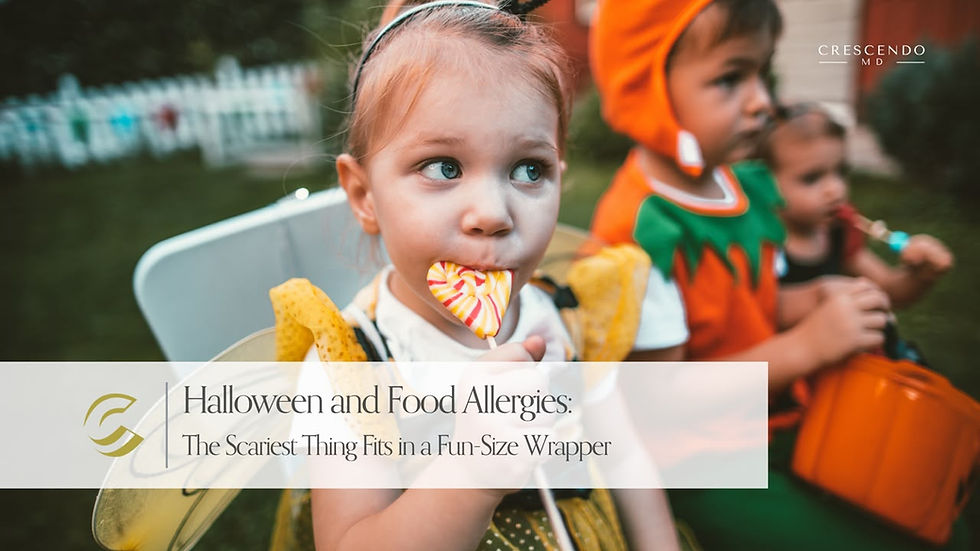
Imagine it's the morning after Halloween. A nine-year-old sits on my exam table, still wearing a little glitter from last night's face paint.
His mom tells the story fast. The street was dark. He was with friends, two houses ahead of her. A neighbor had a big bowl of mini chocolates, and he ate one on the sidewalk. The wrapper was orange and black, with no ingredients printed on it.
Ten minutes later, he was coughing.
His epinephrine was at home. It didn't fit in the costume.
I hear some version of this story every November. Not every family gets a good ending.
Is Halloween really riskier for children with food allergies?
Yes, and we can measure it. Researchers in Canada studied almost 1,400 children who came to emergency rooms with anaphylaxis over nine years. They compared six holidays with the rest of the year.
On Halloween, peanut anaphylaxis was 86% higher than on an ordinary day. Reactions to "unknown nuts" — the child clearly reacted, but no one could say what was in the food — were 66% higher. Christmas, Diwali, Chinese New Year and Eid showed no increase. Only Halloween and Easter did.

"Unknown nuts" may be the most Halloween finding of all: a reaction, and no label to explain it.
Children 6 and older were more likely to react than younger children. That makes sense. Older kids trick-or-treat with friends, eat while they walk, and the parent is half a block behind.
Why is Halloween night different?
Candy is not more dangerous on October 31. What changes is that every safety habit breaks at the same time.
The label is missing. Most small candy has no ingredient list on the wrapper. The fun-size version is also not always made the same way as the full-size bar. The bar your child ate safely in July may not be the mini in the bowl.
Someone else is handing out the food. In a study of more than 500 young children with food allergy, about half of all reactions came from food given by someone other than a parent.
It's dark. Hives are hard to see under a mask or face paint, on a street with poor light. Bring a flashlight.
The epinephrine is at home. Costumes don't have pockets.
Here on the Peninsula, many neighborhoods in Portola Valley, Woodside and Los Altos Hills have few streetlights and no sidewalks. That makes a reaction even harder to spot, and help a little farther away.
The part that worries me most
That same study found something harder to hear. Fewer than 1 in 3 severe reactions were treated with epinephrine. Parents didn't recognize how serious the reaction was, didn't have epinephrine with them, or were afraid to use it.
A 2024 review of fatal food reactions found the same risk factors: epinephrine given late, asthma, and age — teens and young adults carry the highest risk.
Epinephrine rarely fails families. Not having it in reach does.
What I tell families before Halloween
No eating on the walk. Everything waits until you're home, under good light, with every label checked.
No label, no candy. It goes in the trade pile.
Epinephrine travels with the child. Carry two doses in a small bag, or the adult who stays closest carries them. A needle-free nasal spray form of epinephrine is now available and fits in a costume pocket. Ask your allergist if it's right for your child.
Tell the friends. If your child goes out with friends, they should know two things: what your child is allergic to, and where the epinephrine is.
Know the signs. Coughing, throat tightness, vomiting, spreading hives, or a child who suddenly goes quiet and says something feels wrong. Give epinephrine first — an antihistamine is not enough — then call 911.
Do a candy swap. Unsafe candy goes out; a toy, a book or a safe treat comes back.
If you're handing out treats, a teal pumpkin on your porch tells families you have non-food options — stickers, glow sticks, small toys. It costs almost nothing, and it lets a child with food allergy just be a kid at your door.
My child is on oral immunotherapy. Are they protected on Halloween?
Not fully. Oral immunotherapy builds a safety buffer for small accidents. It is not permission for a full candy bar. Give the daily dose as planned, keep the usual rest period after it — running from house to house counts as exercise — and follow the same label rules as everyone else.
Halloween isn't the problem. The dark, the missing labels and the missing epinephrine are. All three can be fixed before your child leaves the house.
If you'd like help building a Halloween plan for your child, our team at Crescendo MD is here. Contact us.
This post is for education, not individual medical advice. Every child is different. If your child has a food allergy, please review your emergency plan with your allergist before Halloween.
I research, direct, and clinically verify every post. I use AI assistance for drafting and data visualization. Every clinical claim here is checked against the primary literature — the references are listed so you can check them too.
References
Leung M, Clarke AE, Gabrielli S, et al. Risk of peanut- and tree-nut-induced anaphylaxis during Halloween, Easter and other cultural holidays in Canadian children. CMAJ. 2020;192(38):E1084–92. doi:10.1503/cmaj.200034
Fleischer DM, Perry TT, Atkins D, et al. Allergic reactions to foods in preschool-aged children in a prospective observational food allergy study. Pediatrics. 2012;130(1):e25–32. doi:10.1542/peds.2011-1762
Novembre E, Gelsomino M, Liotti L, et al. Fatal food anaphylaxis in adults and children. Ital J Pediatr. 2024;50(1):40. doi:10.1186/s13052-024-01608-x
Food Allergy Research & Education (FARE). Tips for trick-or-treating with food allergy.
Dr. Malka is a concierge allergy care physician at Crescendo MD in Portola Valley, California, and a board-certified pediatric allergist and immunologist (FAAAAI, FAAP). He specializes in food allergy treatment and oral immunotherapy (OIT), asthma and eczema care, and concierge pediatric allergy care for children, families, and adults across the San Francisco Peninsula, including Atherton, Woodside, Menlo Park, Palo Alto, and Los Altos.


Comments